Bar closing checklist for small venues
This bar closing checklist walks your team through the nightly close: last call, clearing guests safely, glassware, taps and the ice well, a spirits check, the cash-up and locking the venue. Written for bars with two to eight staff.
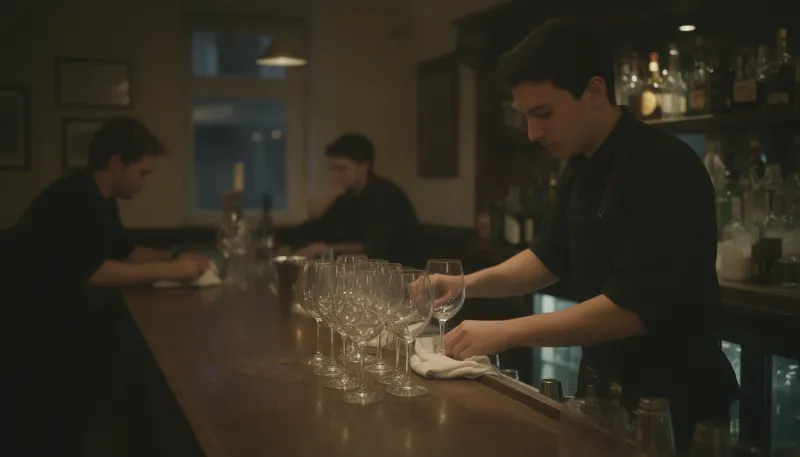
Process flowchart
Step-by-step procedure
What you need
- Glass racks and clean drying cloths
- Surface cleaner and sanitiser (dilute as the label says)
- Container of water for soaking tap nozzles
- Stock sheet
- Till report and deposit bag
- Bin bags for general waste and recycling, and a glass bin
- Torch for checking under tables
- 1
Call last orders Bar staff
Announce clearly and politely that the bar is closing and when the last orders are. Use the music system if you have one, otherwise tell each table. Offer water to anyone who has been drinking. Give guests the drinking-up time your venue allows, often 15 to 30 minutes and sometimes set by your licence, before you start clearing. Note the time of last orders on the stock sheet.
Is a guest too drunk to get home safely? Shift manager
- 2
Get the guest home safely Shift manager only if needed
Follow your venue's policy for intoxicated guests. Usually that means calling a friend or family member or booking a licensed taxi for them, and staying with them until they are collected. Do not let them walk off alone. If a guest is unresponsive, cannot stand or you are worried about their health, call the emergency services and stay with them until help arrives. Write the time and what happened in the incident log.
- 3
Clear the room and check for belongings Bar staff
When the drinking-up time is over, politely ask the remaining guests to leave. Walk the bar, seating areas and toilets to check that nobody is left behind. Look under tables and seats with a torch for phones, wallets and bags, and pick up broken glass with a dustpan, never by hand. Store found items safely for the lost property log. Switch off the music and the room lighting you no longer need.
- 4
Wash and rack the glassware Bar staff
Collect every glass from the bar, tables and shelves. Run them through the glass washer, or wash them in hot soapy water and rinse if you have no machine. Let them air-dry on racks or dry them with a clean cloth. Check each glass for chips or cracks and put damaged ones in the glass bin. Store the clean glasses upside down in their usual places, ready for the next opening.
- 5
Clean taps, ice well and bar surfaces Bar staff
Remove the tap nozzles and leave them to soak in water overnight, then cover or cap the taps. Empty, wash and dry the drip trays. Empty the ice well, rinse it and leave it to dry; never store anything in it. Throw away cut garnishes or cover and refrigerate the ones you keep. Clean the bar top, back-bar shelves and under-bar area with your surface cleaner. Wipe the till and card terminal only with a slightly damp cloth.
- 6
Check key spirits against sales Shift manager
Go through your key spirits and estimate what is left in each open bottle in tenths, or weigh them if you use bottle scales. Subtract from the opening level to get the night's usage, and compare it with what the till recorded as sold. Write both figures on the stock sheet. Note bottles that need replacing for tomorrow. Do not top up or combine bottles.
Does spirit usage match what the till sold? Shift manager
- 7
Recheck stock and log the difference Shift manager only if needed
Recheck the spirits that did not match: the right bottle, the right opening level, any sales rung up under the wrong button. If the difference remains, write it on the stock sheet with possible causes, such as unrecorded drinks, spillage or a breakage. Small differences can wait for the owner or next manager to review; report large ones to the owner the same night, following your venue's escalation rules.
- 8
Count the till and compare with the report Bar staff
Close the till for the night and print the end-of-day report, which shows the expected cash and card takings. Count the cash away from the public, notes first, then coins. Take out tomorrow's float. Compare the remaining cash with the expected cash on the report, and the card terminal's end-of-day total with the card takings. Ask the shift manager to check your count.
Does the till balance with the report? Shift manager
- 9
Recount the till and log the difference Bar staff only if needed
Recount the cash slowly and check that the float came out before you compared. Re-read the report to confirm the expected figure. If there is still a difference, write the expected and actual amounts on the till slip and sign it, together with the shift manager. Never add or remove cash to make it balance. The owner or bookkeeper follows up from the signed slip.
- 10
Seal and store the takings Shift manager
Put the counted cash, the till report and the card terminal's end-of-day slip in the deposit bag and seal it. Store the bag and the float in the safe, or follow your venue's cash procedure. Never leave takings in the till or behind the bar overnight.
- 11
Empty bins and take waste out Bar staff
Take the bar's bins to the waste area and empty them into the larger outside bins, keeping glass, recycling and general waste separate as your collection requires. Put fresh liners in. Pick up any waste missed during clearing, including under the bar. If it is dark or the area is isolated, go out in pairs.
- 12
Lock up and set the alarm Shift manager
Do a final walk through the bar, toilets, store rooms and back of house. Check every door and window is closed and locked. Switch off the lights and the equipment your venue switches off overnight, leaving fridges and cellar cooling running. Set the alarm and check it shows armed. Leave together with the last member of staff and lock the entrance behind you.
Checklist
About this procedure
A bar that closes properly protects its stock, its cash and its people. This checklist turns the nightly close into a fixed sequence so nothing gets skipped when the team is tired after a busy night. It assumes a few staff behind the bar, one person on the till and a shift manager who signs off before leaving.
Keep the checklist on the back-bar wall or near the till where the closing team can see it. Each step names who is responsible, so there is no guessing late at night about who counts the spirits and who sets the alarm. The decision points cover the moments where things can go wrong: a guest who cannot get home safely, and a stock or till count that does not add up.
When you finish, the bar is empty of guests, glasses are washed, taps and the ice well are clean, the spirits check is logged, the takings are counted and stored safely, the bins are out and the alarm is set with every door locked.
Tips and common mistakes
Keep the checklist where you close
Fix a laminated copy on the back-bar wall or near the till where the closing team can see it. Laminating protects it from splashes. Update it whenever your stock list, till or alarm procedure changes, so the team never works from an old version.
Split the close into blocks
On a busy close with three or four staff, give each person a block: glassware, taps and surfaces, bins, and the shift manager on stock, till and lock-up. Saying out loud who has which block stops two people doing the same job while another gets skipped.
Check the floor with a torch
The thing closing teams forget most is the floor under tables and seats. A torch shows dropped phones, wallets and broken glass in seconds. Never feel around with your hands; broken glass is common after a busy night.
Photograph the stock sheet
Once the spirits check is done, photograph the completed stock sheet and send it to the owner. If a difference is questioned the next day, the photo shows exactly what was written at close rather than what someone remembers.
How to adapt this template
- List the key spirits you check each night, and decide which items are counted weekly instead.
- Set the drinking-up time to what your venue allows and your licence permits.
- Add any equipment the template does not cover, such as a coffee machine, slush machine or cocktail station.
- Set your own till difference threshold: some venues recount any difference, others only report differences above a set amount.
- Replace the till steps with your own system's end-of-day routine if your till or payment provider works differently.
Laws and rules differ per country and region. Where a step depends on them, check what applies to your business before you use the procedure.
Frequently asked questions
How long should closing a bar take?
For a small bar with two to four staff, plan 45 to 60 minutes from the last guest leaving to setting the alarm. A venue with a kitchen to close takes longer. If you regularly run over, find the slowest step; it is usually glass washing or the stock check, and both get faster with a fixed routine.
Who should do the cash-up?
The person who ran the till should not be the only one who counts the money. Ideally the bar staff member counts while the shift manager watches or recounts, which catches mistakes and protects both of them. If only one person is closing, count twice and seal the takings before doing anything else.
What if a guest refuses to leave after closing?
Stay calm and do not argue. Repeat that the bar is closed and offer to call a taxi. If they still will not go, follow your venue's policy, which usually means the shift manager speaks to them and, if needed, calls security or the police. Bar staff should not physically remove a guest.
Do I need to count beer as well as spirits?
Most small bars track beer by logging which kegs were started and finished, or by weighing kegs if they have scales, rather than measuring every pour. At minimum, note which kegs ran out tonight so the morning team knows what to change. Spirits are usually where most stock differences appear, so they come first.
More hospitality templates
Restaurant opening checklist and procedure
A daily opening procedure for restaurants, from unlocking the building to opening the doors: security, kitchen equipment and temperature checks, prep, dining room setup and a short team briefing. Written for the opening manager and the first shift.
Restaurant closing checklist
This restaurant closing checklist walks your team through the final hour of service to lock-up: clearing tables, breaking down the kitchen, storing food safely, counting takings, and securing the premises.
Receiving food deliveries procedure for restaurant kitchens
A kitchen receiving routine that covers checking chilled and frozen temperatures, matching the delivery to the order, inspecting packaging and dates, rejecting faulty goods, storing stock first-in-first-out and logging problems with the supplier.