Food allergy procedure for restaurants
This SOP walks a server and kitchen team through handling a guest's declared food allergy from the first question at the table to the plate landing safely in front of them. Designed for small restaurants with 3–50 staff.
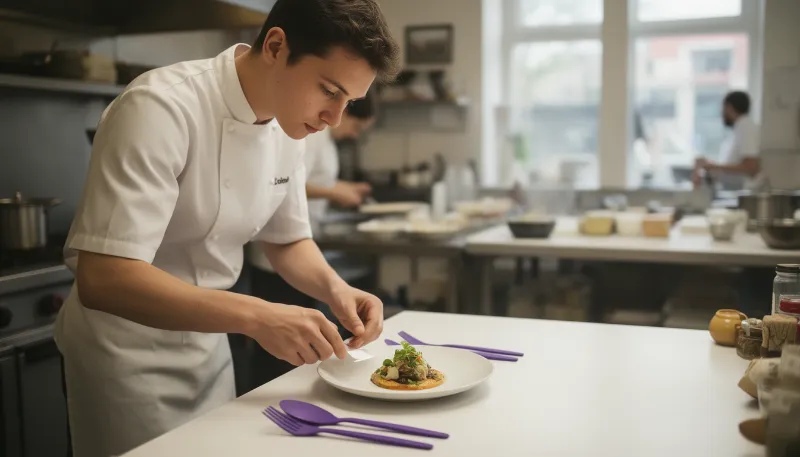
Process flowchart
Step-by-step procedure
What you need
- Colour-coded or flagged order tickets
- Dedicated cutting board and knife set for allergy prep
- Dedicated pan or wok (marked)
- Current supplier allergen sheets per recipe
- Allergen reference card at the pass
- Red marker or highlighter for ticket notes
- 1
Ask every table about allergies and intolerances Server
When taking the order, ask the table: "Does anyone have a food allergy or intolerance we should know about?" If a guest says yes, ask which ingredient exactly (for example peanuts, tree nuts, shellfish, gluten, milk, eggs, soy, sesame or fish). A vague answer such as "I'm a bit sensitive" is not enough to cook safely, so ask once more which ingredient it is. If the guest is unsure, write "ALLERGY – DETAILS UNKNOWN" and tell the head chef straight away.
Does any guest declare a food allergy? Server
Yes: step 2: Record the allergen in capitals on the ticketNo: finish- 2
Record the allergen in capitals on the ticket Server only if needed
Write the allergen name in capital letters at the top of the order ticket, for example "PEANUT ALLERGY – TABLE 4". If your POS has an allergy flag or special-instructions field, activate it so the note prints on every course ticket for that table. Circle or highlight the text so any staff member who glances at the ticket sees it at a glance. Do not rely on memory or a verbal hand-off alone. If the guest has more than one allergy, list each one on its own line.
- 3
Check allergen details for every dish ordered Head chef only if needed
Before confirming the order back to the server, review each dish against your current recipe card and the supplier allergen sheet for that batch. Confirm that no ingredient, sauce, garnish, or shared cooking oil introduces the declared allergen. If a side or topping is made in a shared station, note the cross-contact risk explicitly. Check the date on supplier labels – formulations change without notice. If any component is uncertain or you cannot trace it, treat the dish as unsafe and flag it.
Can the kitchen confirm each dish is safe? Head chef
- 4
Send the order with a verbal confirmation Server only if needed
Send the order through the POS or hand the ticket over at the pass with the allergy note facing up and visible. Do not fold the ticket or put it where the note is hidden. Say it out loud as well: "Table 4, peanut allergy, dedicated prep." Saying it and writing it catches a misread ticket before cooking starts.
- 5
Prepare the dish on a dedicated clean station Line cook only if needed
Clear the workstation of anything that contains or has touched the declared allergen. Use a freshly washed cutting board, knife and pan, or the dedicated set stored for allergy orders. If frying, use oil that has only been used for food without the allergen, or a fresh pot. Do not share tongs, spatulas or garnish between the allergy plate and other plates. Keep the allergy plate apart from other orders at your station so nothing is knocked or dusted onto it.
- 6
Verify plate against allergy spec at pass Head chef only if needed
Before the plate leaves the pass, check four things: it is the right dish, there is no garnish or sauce with the allergen, it was cooked with the dedicated equipment, and the ticket still matches the order. Read the allergy note on the ticket once more. If anything looks wrong, such as the wrong sauce, a swapped garnish or a missing allergy note, send it back. Never let "it should be fine" win over something that looks wrong.
Does the plate match the safe preparation? Head chef
- 7
Serve the dish separately with a verbal note Server only if needed
Carry the allergy plate to the table on its own – do not stack it on top of or alongside other courses. Place it in front of the correct guest. Say clearly: "This dish has been prepared without [allergen] on dedicated equipment. Please check before eating." If the guest asked for a specific substitution, confirm what was done. Do not say "it's allergen-free" – say "prepared without [X]" because trace amounts cannot be ruled out in any shared kitchen.
- 8
Discard the plate and remake from scratch Line cook only if needed
Take the plate back and discard it fully – do not simply swap a garnish. Wipe down the workstation, replace any tool that may have contacted the allergen, and start the dish again from a clean state. Re-mark the ticket if it came off or was folded during the first attempt. The head chef must re-check the remake at the pass before it goes out. Note the incident on the kitchen whiteboard or in your service log so the next shift is aware of what happened.
- 9
Tell guest the dish cannot be guaranteed safe Server only if needed
Go back to the table and say plainly: "I'm sorry, we can't guarantee [dish] is safe with a [allergen] allergy because of how it is prepared here." Do not play it down and do not suggest another dish before the kitchen has checked it. Ask whether they would like to choose something else or leave the item out. Never pressure a guest to accept a dish the kitchen cannot confirm.
Does the guest choose another dish? Server
Yes: step 3: Check allergen details for every dish orderedNo: finish
Checklist
About this procedure
A guest's allergy is the one order where a mistake can cause real harm, not just a complaint. This procedure gives your front-of-house and kitchen a single sequence to follow so the allergen never gets lost between the table, the ticket, and the pass. It assumes you have current recipe sheets and supplier allergen information on file. If you do not, sort that out before putting this SOP into use.
The procedure covers six moments: asking at the table, recording the allergy, checking every dish against your allergen data, preparing on clean dedicated equipment, verifying the plate at the pass, and serving it separately with a clear verbal note. One decision point lets you tell a guest honestly when you cannot guarantee a dish is safe, which protects them and protects your team.
Roles are kept simple – server, head chef, line cook – so any small restaurant can adopt it without renaming positions. Adapt the steps to your POS system, your ticket format, and the allergen list your local food safety rules require you to display or provide.
Tips and common mistakes
Keep supplier allergen sheets updated weekly
Formulations change without notice. Set a recurring task for the head chef or a designated team member to check that every supplier allergen sheet in the kitchen is current and matches what actually arrived this week. File old versions separately so you can trace what was on the menu last month if an incident occurs.
Store dedicated allergy tools in one labelled spot
A separate cutting board, knife, pair of tongs, and a pan stored together under a label such as "ALLERGY PREP – WASH BEFORE USE" remove the guesswork. If the tools are scattered or shared, they will end up on a regular plate by mid-service. Wash them before and after every allergy order.
Brief active allergy tickets at shift handover
If an allergy order spans two shifts or the kitchen changes over, mention it verbally at handover: "Table 4 is still under a peanut allergy – dedicated prep until they finish." A written note on the whiteboard helps, but the verbal reminder catches people who walk past the board.
Never say "allergen-free"
In any shared kitchen, trace amounts are unavoidable. Train every server to say "prepared without [X]" rather than "allergen-free." The first phrasing is accurate; the second is a guarantee no kitchen can make and can create false confidence in a guest.
How to adapt this template
- Replace the generic allergen list in the asking step with the specific allergens your local food safety rules require you to identify and communicate (check what your local authority lists).
- Adapt the ticket-marking step to your actual POS or ordering system – spell out the exact field, flag colour, or sticker your team uses so a new server can replicate it without asking.
- Define what "dedicated clean station" means in your kitchen: which shelf holds the allergy tools, how many sets you keep, and where the dedicated oil pot lives during service.
- Set your own threshold for when a dish is "uncertain." Some kitchens treat any shared-sauce risk as a no-go; others allow it if the sauce is freshly made. Decide and write it into the check step so every shift applies the same standard.
- Add your restaurant's name, allergen reference card location, and the head chef's phone or radio channel to the top of the printed SOP so the team can find help quickly during a busy service.
Laws and rules differ per country and region. Where a step depends on them, check what applies to your business before you use the procedure.
Frequently asked questions
What if a guest mentions an allergy after their food has already been served?
Take the plate back immediately. Ask the guest what they are allergic to, then run the allergen check on that dish as if it were a new order. If the kitchen cannot confirm it was safe, do not let them eat it – offer a fresh preparation made under this procedure or a different dish. Apologise for the delay without over-explaining.
Can I use the same fryer oil for an allergy order?
No, not without checking. Oil picks up proteins from everything fried in it before, such as battered fish (fish and gluten) or prawns (shellfish). Use oil that has only been used for food without the allergen, or a fresh pot. Check what your local food safety guidance says about shared frying oil.
A guest says they are "a bit sensitive" but won't name an allergen. What do I do?
Ask once more, calmly: "Just so I can flag it correctly, which ingredient is the problem?" If they still cannot say, write "ALLERGY – DETAILS UNKNOWN" on the ticket and ask the head chef to come to the table. The kitchen can only make a dish safe for an allergen it knows, so the head chef explains which dishes are simplest and what is in them.
Does this procedure change if we use a POS system instead of paper tickets?
The logic stays the same; only the recording step changes. Use your POS allergy flag or special-instructions field so the note prints on every course ticket for that table. Test it before service: place a dummy order with the flag on and confirm the kitchen printer shows the allergen in large, visible text. If your system cannot print it clearly, add a physical red sticker to the screen.
What do we do if a guest has an allergic reaction?
Call the emergency number straight away and say it may be anaphylaxis. If the guest has an adrenaline auto-injector, help them use it. Stay with them, do not let them walk off alone, and tell the manager. Keep the plate and the ticket so you can check later what was in the dish.
More hospitality templates
Restaurant opening checklist and procedure
A daily opening procedure for restaurants, from unlocking the building to opening the doors: security, kitchen equipment and temperature checks, prep, dining room setup and a short team briefing. Written for the opening manager and the first shift.

Restaurant closing checklist
This restaurant closing checklist walks your team through the final hour of service to lock-up: clearing tables, breaking down the kitchen, storing food safely, counting takings, and securing the premises.
Receiving food deliveries procedure for restaurant kitchens
A kitchen receiving routine that covers checking chilled and frozen temperatures, matching the delivery to the order, inspecting packaging and dates, rejecting faulty goods, storing stock first-in-first-out and logging problems with the supplier.