Restroom cleaning checklist for site cleaning teams
A step-by-step restroom cleaning checklist for cleaning technicians working commercial and public sites, covering sanitising, restocking, and signing off the service log for each stop on your route.
Process flowchart
Step-by-step procedure
What you need
- Disposable nitrile gloves
- Wet floor A-frame sign
- Toilet/bowl cleaner (per product label dilution)
- All-purpose cleaner and glass cleaner
- Color-coded microfiber cloths (red, blue, yellow)
- Mop with interchangeable head and bucket
- Bin liners
- Replacement consumables: toilet paper, hand soap, paper towels
- Service sheet or cleaning app
- 1
Set up at the restroom entrance Cleaning technician
Place the wet floor A-frame sign at the doorway before you start cleaning. Put on fresh disposable gloves. Check your trolley or caddy has everything listed in the service plan: toilet cleaner, all-purpose cleaner, glass cleaner, microfiber cloths in the correct colors, mop, bucket, bin liners, and replacement consumables. If anything is missing from your trolley, grab it from the stock room before you begin so you do not have to leave mid-clean.
Any damage or overflow you cannot fix on the spot? Cleaning technician
- 2
Report the issue and make the area safe Cleaning technician only if needed
Stop and note the issue on your service sheet: what is broken, where, and how severe. Take a photo if your phone is available and the client allows it. Tell the site supervisor by radio or text. If it is an active overflow or water leak, put up a second sign and do not mop that area until the water source is dealt with. Do not attempt to repair plumbing or fixtures. Once the immediate slip hazard is managed, continue cleaning the rest of the restroom.
- 3
Clean toilets and urinals Cleaning technician
Apply toilet cleaner to the bowl interior, rim, and underside of the seat using the dilution and contact time stated on the product label. Let it sit for the full dwell time. Scrub with a dedicated toilet brush or red microfiber cloth, working from under the rim down to the waterline. Flush to rinse. Wipe the exterior: tank top, flush button, base, and any visible limescale. For urinals, apply cleaner, wait the contact time, scrub the interior surface, and rinse with the flush. Wipe the exterior chrome or ceramic.
- 4
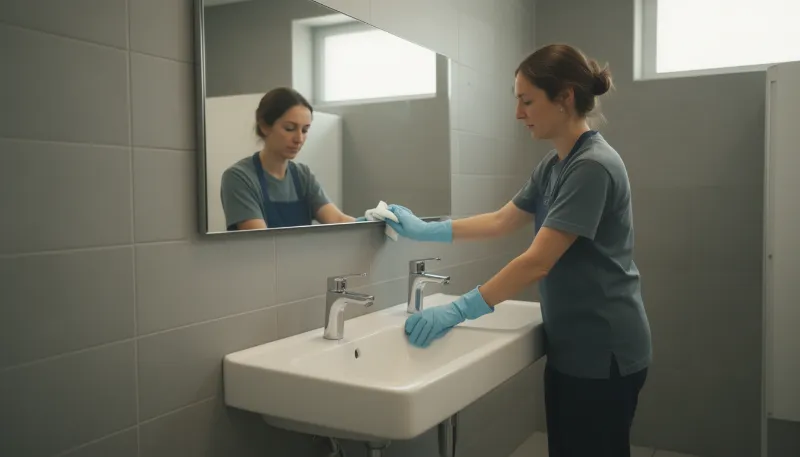
Clean sinks, mirrors, and tap handles Cleaning technician
Wipe the sink basin, drain, and overflow with all-purpose cleaner on a blue microfiber cloth. Rinse with clean water if the product label requires it. Clean the tap handles and lever to remove soap scum and fingerprints. Apply glass cleaner to the mirror in an S pattern, then wipe dry with a separate clean glass cloth. Wipe the underside of the sink lip and the wall tile directly behind it, where splashes collect between cleans.
- 5
Sanitise all touch points Cleaning technician
Using the disinfectant or sanitizer specified in your service plan, wipe every surface a person touches: door handle and push plate, light switch, flush button or lever, paper towel dispenser exterior, soap dispenser exterior, bin lid if hinged, and any handrail. Work from top to bottom. If the product has a stated contact time, wait before wiping dry. Switch to a fresh cloth side or a new cloth if the current one is visibly soiled.
- 6
Empty bins and replace liners Cleaning technician
Remove the full liner, tie the top, and place it in the main waste bin, not the restroom bin. Never push the bag down or reach into it: watch for needles or other sharps, and if you see one, do not touch it; follow the site's sharps procedure or call the site supervisor. Fit a fresh liner and tuck the edges neatly into the bin so no gap shows at the rim. If the bin is a pedal or sensor type, wipe the pedal or sensor area with your all-purpose cloth. Make sure the bin sits flat and is not overfilled before you move on.
- 7
Mop the floor Cleaning technician
Start mopping from the farthest corner of the restroom and work toward the exit, overlapping each pass slightly so no strip is missed. Use a clean mop head with water and floor cleaner at the dilution on the product label. Wring the mop well; it should be damp, not dripping. Mop around the base of toilets and bins, under the sink if accessible, and along the wall edges. Let the floor air-dry before removing the wet floor sign.
- 8
Restock all consumables Cleaning technician
Check every dispenser and holder against the levels in your service plan. Roll toilet paper to the correct count, typically one full roll plus a spare in the holder. Refill hand soap if it is below the quarter mark. Replace paper towel rolls if low. Wipe any dust off the outside of dispensers while you are at them. If the client specifies a particular brand or product, use only that; do not substitute from your own stock.
Are all supplies at the level in the service plan? Cleaning technician
- 9
Note supply gaps and notify office Cleaning technician only if needed
Write down exactly what is missing or running low on the service sheet: item name, quantity needed, and which restroom it belongs to. Send this to the office or dispatcher before you leave the site so they can include it in the next delivery or reorder. If you have a spare on your trolley and the client allows substitution, use it and note that on the sheet. Do not leave a dispenser empty without flagging it.
- 10
Do the final visual check Site supervisor
Step back to the doorway and look at the restroom as a client would see it. Check for streaks on mirrors or glass, water spots on chrome, missed spots on the floor especially in corners and under bins, any product smell that is too strong, correct signage in place, and that no cloth, glove, or tool is left behind. Open each door to check the back panel. Look under the sink. Note anything that is off.
Does the restroom pass the final check? Site supervisor
- 11
Fix identified issues and re-check Cleaning technician only if needed
Address whatever failed the check: re-wipe a streaked mirror, re-mop a wet spot, replace a missed roll of paper, or pick up a forgotten cloth. Once fixed, repeat the final visual check from the doorway. Only proceed to sign-off when every item passes. If the issue is something you cannot fix, such as a cracked tile or a running tap, note it on the service sheet and move on.
- 12
Sign and date the cleaning log Site supervisor
On the service sheet or in your client's app, record the date, time finished, restrooms completed, any issues noted, and any supply gaps flagged. Sign and initial, or enter your digital credentials. This is your proof of service for the client and for your own company records. Do not sign until the restroom actually passes; a signed log with visible dirt undermines trust faster than a late arrival does.
- 13
Pack up and secure the area Cleaning technician
Remove the wet floor sign once the floor is fully dry. Collect all cloths, brushes, and tools; rinse reusable items in your bucket. Put dirty cloths in the laundry bag on your trolley, not in the restroom bin. Return the mop to its rack or trolley position. If you have a key to the restroom or a floor area, return it to the lockbox or hand it to the site contact per your client's procedure. Lock the door if the service plan requires it.
Checklist
About this procedure
This procedure walks a cleaning technician through one full restroom clean at a client site, from setting up the wet floor sign to signing the service log. It assumes you are working as part of a scheduled route with a defined service plan that lists which products to use, what consumables to restock, and how often each stop is visited.
For a cleaning business, consistency across stops and across shifts is what keeps clients renewing contracts. A signed log with a specific sequence of steps gives your office proof of service, gives the client confidence, and gives your team a clear standard so one technician does not skip touch points while another over-mops the floor.
Adapt the restock levels, product names, dilution ratios, and sign-off method to match each client's service plan. The structure stays the same whether you are cleaning two restrooms in a small office or twelve across a retail park with high foot traffic and mid-day touch-point wipes built into the schedule.
Tips and common mistakes
Color-code your cloths and stick to it
Red for toilets, blue for sinks and glass, yellow for touch points. If a cloth gets mixed up or is too soiled to identify, bin it and grab a fresh one. A toilet cloth used on a mirror or tap spreads germs to the surfaces people touch with their hands and face.
Check behind the door and under the sink
These are the two spots people never see but you will if you crouch down. A ring of grime on the back of a door panel or a drip stain under the sink lip is what separates a good clean from a thorough one.
Carry one spare roll of everything
Keep an extra roll of toilet paper, a backup soap bottle, and a spare paper towel roll in your trolley. If a dispenser is empty and you do not have the exact brand, flag it on the service sheet rather than leaving the holder bare.
How to adapt this template
- Set the restock levels (rolls per holder, soap refill threshold) to match each client's service plan
- List the exact product names and dilutions your team uses so technicians do not guess at the trolley
- Define who does the final visual check: the technician themselves on a solo route, or the site supervisor on multi-stop routes
- Specify the sign-off method per client: paper service sheet, shared spreadsheet, or the client's own facilities app
- Add any site-specific steps such as cleaning a public-facing mirror at a reception desk or restocking a specific number of urinals
Laws and rules differ per country and region. Where a step depends on them, check what applies to your business before you use the procedure.
Frequently asked questions
How often should a commercial restroom be cleaned?
It depends on your client's service plan and foot traffic. High-traffic sites like restaurants or retail may need mid-shift touch-point wipes in addition to the full clean. Check the frequency written in each contract; do not assume daily is enough for a busy venue.
What if I find a maintenance issue like a leaking tap or broken seat?
Note it on the service sheet with a photo if possible, tell the site supervisor, and continue cleaning everything else. You are not responsible for repairs. The supervisor or office raises the work order with the client's facilities team. Do not attempt to fix plumbing yourself.
Do I need to clean during business hours?
Some service plans require a mid-day touch-point wipe while the building is occupied, in which case you work quickly and quietly, avoiding high-traffic moments. Others are strictly out-of-hours. Follow the time window in your route sheet; if it is unclear, ask the site supervisor before entering.
Can I substitute my own brand of soap or paper towels?
Only if the client's service plan allows it or you have written approval. Clients often specify products for cost control, allergen reasons, or branding. If you substitute without permission and the client notices, it becomes a contract issue rather than a cleaning issue.
More cleaning templates
Office cleaning checklist for routine office cleans
This procedure walks a cleaner through a standard commercial office clean from arrival to sign-off, covering waste, surfaces, kitchen, toilets, floors, restocking and reporting any damage or maintenance issues found on site.
Airbnb cleaning checklist for turnover cleans
A complete turnover procedure for a small cleaning crew working between short-stay guests: confirm checkout, report any damage with photos, wash all linen, clean every room, restock supplies, and reset the property to match the listing before locking up.
Move out cleaning checklist for end-of-tenancy deep cleans
A step-by-step procedure for a cleaning team carrying out an end-of-tenancy or move-out deep clean, from the pre-job inventory walk-through to the final photo inspection and sign-off.